Complete a Pokemon Master Set Without Going Broke
A step-by-step approach to finishing a pokemon master set: when to stop opening packs, when singles prices drop lowest, and where to buy in Australia.
Contents
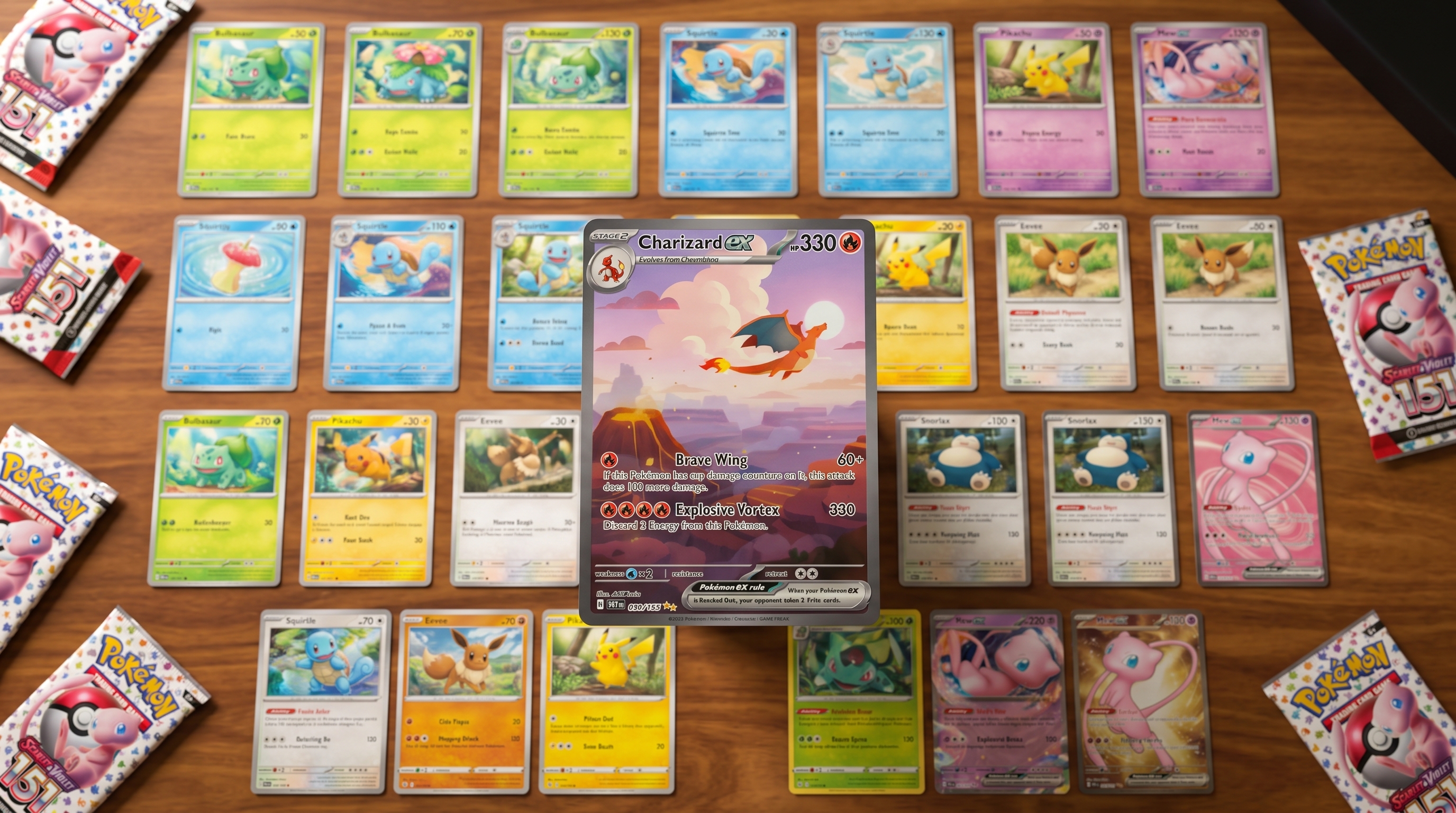
A pokemon master set is 360 cards. Or 438. Or 102. The number depends on which set you choose and how you define "master." But the number is never the reason people overspend. The reason is method and timing: opening packs past the point of efficiency, buying singles at week-one prices, and chasing reverse holos of commons one at a time instead of batching purchases from a single seller.
What actually counts as a pokemon master set
There is no official Pokemon definition of a master set. Pokemon does not send you a certificate when you finish. The goal is collector-defined, and the community has settled on three tiers.
| Tier | What it includes | Example (151) |
|---|---|---|
| Complete Set | One of every numbered card in the set | 165 cards |
| Master Set | All base cards + reverse holos + secret rares | 360 cards |
| Grand Master Set | Master set + Black Star promos, store-exclusive stamped cards, non-holo deck variants, and STAFF stamped cards | 438 cards |
That jump from 165 to 360 is why costs balloon. A master set can double or even triple the total card count compared to a complete set. Decide your tier before you spend a dollar. Every card you add to the scope adds cost, storage, and tracking overhead.
If this is your first attempt, a complete set is a perfectly respectable goal. You can always upgrade to master later by filling in reverse holos and secret rares.
How much does a pokemon master set actually cost
Cost varies enormously depending on the set, your method, and when you buy. In Reddit discussions, community members have shared anecdotal figures that illustrate the range: one user described spending around €4,000 on a 151 master set, while others estimated SV Base at roughly €1,000 to €2,000. These are personal reports, not market averages, but they show how wide the gap can be.
For vintage pre-built master sets on the secondary market, listed prices range from $610 for a Jungle Complete Master Set (MP-DMG condition) up to $4,345 for a near-complete WOTC Black Star promo set.
The takeaway: method matters more than set selection. Timing and discipline with singles can cut the cost of any modern master set substantially.
The pack-opening decision: when to stop ripping
This is where most collectors bleed money. Opening packs is fun. It is also statistically brutal past a certain point.
Opening 3 to 4 booster boxes typically yields 80 to 90 percent of a modern set. That is your sweet spot for the ripping experience. Past that threshold, you are paying pack price for duplicates you do not need.
The maths tilts toward singles earlier than most people think. According to CardRake's singles buying guide, singles are almost always more cost-effective when you still need more than 60 to 70 percent of a set. The booster box route is really about the experience, not efficiency. Open your 3 to 4 boxes for the fun of it, then switch.
One approach shared in a Reddit collecting discussion: open under 100 packs, then buy the missing cards over the next year or two. That kind of patience is what separates a budget-friendly master set from an expensive one.
The reverse holo trap
Reverse holos of commons and uncommons are the most tedious part of any pokemon master set. Some collectors have regretted committing to hunting down multiple versions of every common and uncommon in large sets like 151.
One workaround: use regular versions as placeholders and only upgrade to a reverse holo when you happen to pull one. This is technically not a master set by strict definition, but it cuts the grind significantly while you work toward full completion at your own pace.
Live eBay Deals
Sponsored · #ad SAVE $80.36
Pokémon TCG Scarlet & Violet Surging Sparks Booster Bundle Sealed x3 AVAILABLE *
 SAVE $457.35
Pokémon TCG Shining Fates Elite Trainer Box Factory Sealed

Get notified immediately.
Receive alerts when stock is available, so you don't miss out.
Pulled something worth grading? Ark Grading does it in Melbourne, no overseas shipping, no 5-month wait. CardTracker readers get 5% off with code CARDTRACKER.
Grade with Ark →When to buy: timing saves hundreds
Pokemon card prices follow a predictable lifecycle:
- Week 1: Peak FOMO pricing. The worst time to buy singles.
- Weeks 2 to 4: Prices begin dropping as supply increases.
- Months 2 to 4: The sweet spot. Hype has faded, supply is healthy.
- Months 6 to 12: Gradual appreciation as supply tightens.
- 12+ months: Vintage territory with unpredictable spikes.
That 2 to 4 month post-release window is where you want to do the bulk of your singles buying.
Seasonal patterns matter too. January and February see a dip as people sell holiday gifts for cash. September through December is the worst window, with prices inflated by holiday demand and nostalgia spending.
Price alert tools are your friend here. Set alerts on the sealed product and singles you are targeting so you catch the dips without refreshing listings daily.
Where to buy singles for the lowest prices
Different platforms suit different price tiers.
Under $50 cards: TCGPlayer (US) and Cardmarket (EU) offer competitive pricing and buyer protection. TCGPlayer's "optimize cart" feature consolidates purchases from fewer sellers, which reduces shipping costs on larger orders.
High-value cards: Auction formats reward patience. Sniping auctions that end at odd times can yield significant discounts on chase cards compared to Buy It Now listings.
Condition-sensitive purchases: Local card shops allow in-person inspection, which matters for anything going into a graded submission or a centrepiece page in your binder.
The shopping list method
Random buying is budget death. Before you start purchasing singles, build a complete want list with current market prices. Sort by price per card, tackle the expensive ones first while your budget allows, group purchases by seller to minimise shipping, and set price alerts for anything outside your target range.
This systematic approach turns a vague "I need about 80 more cards" into a concrete line-item budget you can track week by week.
Picking a set for your first pokemon master set
Not every set demands the same effort. Smaller sets with fewer reverse holos and a lower secret rare count are cheaper and faster to complete.
Pokecottage maintains master set guides spanning Sword and Shield through current Scarlet and Violet releases including Pitch Black and Chaos Rising. Each guide breaks down the exact card count and variant list so you can calculate scope before you commit.
For Australian collectors, timing your sealed product purchases matters. The three to four boxes you open at the start of your master set journey are the foundation of the whole project. Getting those at a good price compounds savings across every card you pull.
The sequence that works
Putting it into a step-by-step:
- Pick your set and tier. Use a master set guide to count the exact cards you need. Know the number before you spend.
- Open 3 to 4 booster boxes. Enjoy the rip. Track what you pull. Stop when you hit roughly 80 to 90 percent of the base set.
- Wait 2 to 4 months post-release. Let FOMO pricing collapse. Use the time to sort, sleeve, and organise what you have.
- Build your want list. Every missing card, priced at current market value. Sort expensive cards first.
- Buy singles strategically. Group by seller, use cart optimisation, and target the January to February seasonal dip if the timing lines up.
- Track the last 10 percent. The final cards are the slowest. Set alerts and be patient. A master set is a months-long project, not a weekend sprint.
The collectors who finish without going broke are the ones who treat it as exactly that: a project with a budget, a timeline, and a method. The cards will still be there in two months. Your wallet will thank you for waiting.
Live eBay Deals
Sponsored · #ad SAVE $191.45
Pokemon TCG Scarlet & Violet 151 Booster Bundle Sealed New (6 packs)
 SAVE $150.41
3x Pokémon Scarlet & Violet Prismatic Evolutions Sealed Elite Trainer Box ETB

Explore CardTracker.au
📬 Monthly TCG Updates and Market Recap
Sign up for our mailing list. No spam - just the best deals and local market trends.
Please check your spam folder for the confirmation email!