Best Toploaders and Card Savers for Pokemon Cards
Which pokemon card toploaders to use for storage, display, and shipping, and why card savers are what you need for PSA grading submissions instead.
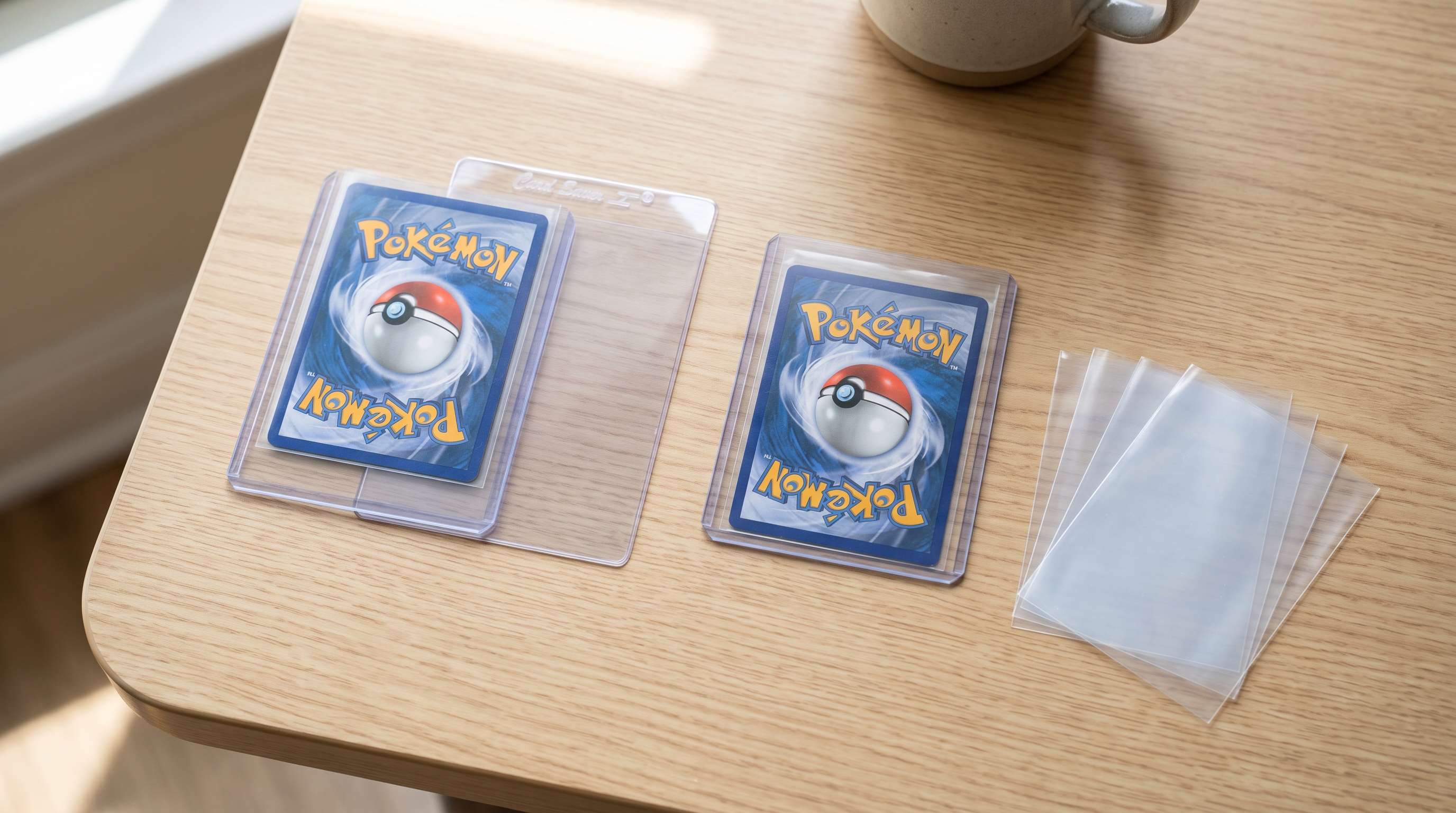
You pulled something good. A full-art trainer, a holo rare, maybe an alt art that made you put the pack down and reach for your phone. The next thing you do with that card matters more than most new collectors realise.
Pokemon card toploaders are rigid plastic holders that protect cards from bending, surface damage, and edge wear. They cost anywhere from $0.08 to $0.15 each for budget brands, up to about 25 cents each at retail. But toploaders are not the right choice for every situation. If you are sending cards to PSA for grading, you need card savers. If you are storing long-term near a window, you need UV-blocking toploaders. And no matter which holder you pick, you need a penny sleeve underneath.
This guide covers the sizing, the use cases, and the specific products that work for Pokemon cards.
What size toploader do Pokemon cards need?
Standard Pokemon cards measure 2-1/2" x 3-1/2" (63.5mm x 88.9mm). That is the same dimension as Magic, sports cards, and One Piece TCG cards.
The number on a toploader (35pt, 55pt, 100pt) refers to the thickness of card it can hold, not the toploader itself. A standard Pokemon card is roughly 20pt thick. Add a penny sleeve and you are still well within range of a 35pt toploader.
A 35pt toploader fits any standard trading card when used with a penny sleeve. That is the size you want. If your sleeved card slides in with gentle resistance, the fit is correct.
When would you need something thicker? 55pt toploaders are designed for cards with embedded fabric, like jersey or relic cards, or thick Chrome inserts. Standard Pokemon cards, including full arts, V-Stars, and secret rares, do not need them.
Which cards are worth putting in a toploader?
At 10 to 15 cents per toploader, the cost is low enough that you do not need to agonise over the decision. But you also do not need to topload every common and uncommon in your collection.
The practical threshold: if the card is holo, full art, V-Star, alt art, or otherwise rare enough that you would be annoyed to find it bent, it belongs in a toploader. Common and uncommon bulk can sit in penny sleeves inside a storage box. If you are unsure whether a card has value, that is worth checking before you decide how to store it.
For everything else, a penny sleeve alone is fine. Toploaders are cheap, but so is the card they would be protecting if it is a regular holo from a recent set.
Are toploaders good for Pokemon cards?
Yes. For storage, display, and shipping, toploaders are the standard. Their stiff, rectangular shape makes them stackable and easy to organise in boxes or drawers. You can file many toploaded cards together without them tipping or bending.
But toploaders have one significant limitation: they are not the right format for grading submissions. If you plan to send cards to PSA, read the card savers section below. The protection toploaders offer is excellent for everything except that one use case.
The penny sleeve rule
Every toploader or card saver needs a penny sleeve underneath. This is not optional.
Penny sleeves are ultra-thin, inexpensive clear sleeves that cost a cent or two each and add virtually no thickness. They serve as the inner layer that prevents the card surface from rubbing directly against the rigid plastic of the toploader. Without a penny sleeve, the card can shift inside the holder. The sleeve adds friction so the card does not move much.
The loading process: slide the card into the penny sleeve, then slide the sleeved card into the toploader. For shipping, place the loaded toploader into a resealable team bag. Never tape a toploader directly, because adhesive leaves residue on the PVC. Seal the team bag instead.
Live eBay Deals
Sponsored · #ad SAVE $195.79
10x Pokemon Paldean Fates Booster Bundle, Perfect Order, Chaos Rising Sealed
 SAVE $489.44
Scarlet & Violet: Black Bolt Elite Trainer Box Pokémon TCG English 151 2025

Why PSA does not want toploaders
This catches a lot of first-time grading submitters off guard. PSA's official submission guide is direct: submissions received in top loaders, hard acrylic cases, or screw-down holders will experience delays in processing and the cases will not be returned.
The alternative is a card saver. Card savers are semi-rigid holders made of flexible plastic that hold the card more snugly than a toploader.
If you send cards to PSA in toploaders, they will still grade them, but they may remove the card and not return your toploader. Use Card Saver 1 holders for grading submissions. If you are preparing cards for PSA, the grading process guide covers the full submission workflow, and centering is worth checking before you pay for a slab.
UV protection: the upgrade most collectors skip
If your cards sit in a display case, on a shelf, or anywhere near a window, this matters. Standard toploaders offer zero UV protection. Clear PVC is essentially transparent to ultraviolet light.
The damage is slow and cumulative. UV exposure causes colour fading (reds and yellows go first), surface yellowing on white borders, and ink degradation where holographic layers lose their reflective properties.
This is particularly severe for holographic and foil cards. Pokemon V-Star cards, Prizm parallels, and refractors all rely on light interaction for their visual impact. A hazy, UV-degraded toploader dampens that effect.
Premium UV-blocking toploaders exist. Some use single-frame construction, where one continuous piece of PVC is folded in half, eliminating the bottom weld seam and producing a cleaner optical path. They cost more, but for cards you plan to display long-term, especially holos and alt arts, the upgrade is worth it.
Best toploader brands for Pokemon cards
Two brands dominate the market for good reason.
Ultra Pro produces high-quality toploaders that are consistent, solid, reasonably priced, and acid-free. Acid-free matters for long-term storage: it means the PVC will not discolour your cards over time.
BCW is a reliable and trustworthy brand known for dependable protection. They can be purchased in larger packs, which is useful if you want uniformity across a sizable collection.
On price, budget toploaders from Ultra Pro and BCW run $0.08 to $0.15 each. At retail from some suppliers, Ultra Pro toploaders run closer to 25 cents per sleeve, so shopping around pays off. Buying in bulk (500 to 1,000 packs) saves 30 to 50% compared to small packs.
Either brand will protect your cards. The choice comes down to availability and pack size preference rather than a meaningful quality gap.
Card savers vs toploaders: quick reference
| Toploader | Card Saver 1 | |
|---|---|---|
| Material | Rigid PVC | Semi-rigid flexible plastic |
| Best for | Storage, display, shipping | Grading submissions |
| PSA accepted | Accepted but causes delays; holder not returned | Endorsed by PSA |
| Card fit | Card can shift slightly (penny sleeve helps) | Snug fit, minimal movement |
| Price | $0.08 to $0.25 each | ~$0.13 each |
| Penny sleeve needed | Yes | Yes |
Card Savers come in sizes 1 through 5, but Card Saver 1 and Card Saver 2 are the only sizes for standard trading cards. CS1 is the grading standard. CS2 is slightly smaller and costs about 11 cents each.
The decision is straightforward. If you want to store cards at home, a toploader is easier to use and store. If you want to get cards graded, Card Savers have the advantage of PSA endorsement. Most collectors end up owning both.
Live eBay Deals
Sponsored · #ad SAVE $409.92
Pokémon Center Pokémon TCG 30th Celebration Elite Trainer Box Pikachu 6+
 SAVE $405.79
Pokémon TCG 30th Celebration Pokémon Center Elite Trainer Box (ETB) | in Hand

📬 Monthly TCG Updates and Market Recap
Sign up for our mailing list. No spam - just the best deals and local market trends.
Please check your spam folder for the confirmation email!