Japan Wants to Regulate Pokemon Cards: What Australian Collectors Need to Know
Japan's LDP is studying Pokemon card regulation amid scalping and counterfeit concerns. Here's what the My Number ID system and proposed rules mean for Australian collectors.
Contents
The headlines about Japan regulating Pokemon cards sound like bad news for collectors. They are not. What Japan's government is actually doing - setting up a study group to crack down on scalpers, counterfeiters, and money launderers - should make Japanese product cheaper and more accessible in the long run. The real risk for Australian collectors is not regulation. It is the parts of the market regulation cannot reach.
Japan Isn't Banning Pokemon Cards. It's Setting Up a Study Group
Japan's ruling Liberal Democratic Party has established a parliamentary group to study the trading card market. This is not a ban, and it is not legislation. The group's chair, Kihara Seiji, has already drawn a clear line: the group "must not strengthen regulations to the point of destroying the market." He pointed to Japan's cryptocurrency industry as a cautionary tale. Strict regulation pushed it to the United States, and he wants to avoid repeating that mistake with trading cards.
The LDP's stated goals are practical: establish rules to prevent counterfeit cards, better restrict bulk purchases for resale, promote the industry, and support overseas expansion. The group begins as a forum for discussion between lawmakers, government ministries, and industry representatives. It is not expected to introduce new laws immediately. A lawyer consulted on the issue noted that any Japanese law would only apply within Japan, so international cooperation would be essential.
Why the Market Got Too Big to Ignore
The trading card market has grown every year since 2017, reaching about 338.4 billion yen (US$2.3 billion) in fiscal 2025. That is a 90% increase across four years.
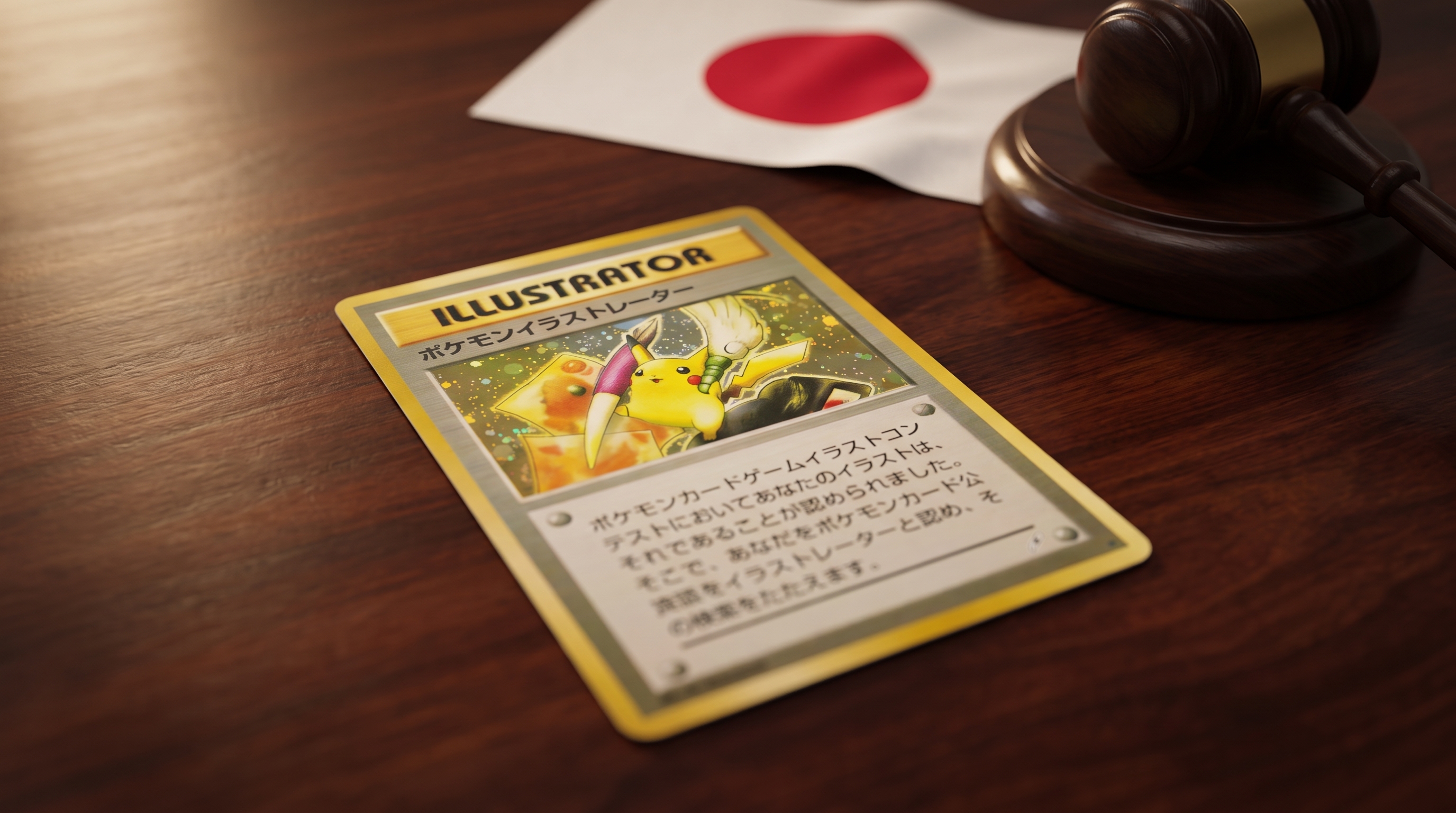
A single sale crystallised how far things had come. In February 2026, YouTuber Logan Paul sold a Pikachu Illustrator card for about $16 million. The card was one of only 40 issued in 1998, and the only one given a grade of 10. The prices are not confined to one-of-a-kind grails. A Tokyo card store recently sold a well-preserved Pikachu from the very first booster pack for about 10 million yen, roughly $89,000.
The LDP group also heard something that stung: card values are largely determined by a US company, despite the Japanese origins of Pokemon and Yu-Gi-Oh. A market born in Japan is being priced in America, and the government wants more say over its own creation.
The Three Problems Regulators Are Chasing
The Japanese government set up a taskforce to address three specific problems: scalping, counterfeiting, and money laundering.
Counterfeit cards have become increasingly sophisticated. In a market where high-value cards trade as investment assets, the incentive to fake them is enormous. Even Logan Paul, who made millions from the trade, fell victim to a box of fake cards that cost him almost $5 million.
Scalping has made it nearly impossible for genuine fans to buy new releases at retail price. Stores have improvised their own defences: one shop snipped corners off packs to make them less appealing to resellers, another made customers pass a Pokemon quiz before buying. The LDP group wants to formalise these kinds of protections. Its primary goal is to establish rules that prevent counterfeit cards and better restrict bulk purchases for resale.
Money laundering is the third concern. Authorities worry that expensive trading cards could be exploited for illicit overseas money transfers because of their high resale value.
The Measures Already Live
The government is not waiting for the parliamentary group to finish its work. Two concrete anti-scalper measures are already in place.
Live eBay Deals
Sponsored · #ad SAVE $464.48
Pokémon TCG Shining Fates Elite Trainer Box Factory Sealed
 SAVE $143.73
3x Pokémon Scarlet & Violet Prismatic Evolutions Sealed Elite Trainer Box ETB

Get notified immediately.
Receive alerts when stock is available, so you don't miss out.
Pulled something worth grading? Ark Grading does it in Melbourne, no overseas shipping, no 5-month wait. CardTracker readers get 5% off with code CARDTRACKER.
Grade with Ark →From August 2026, certain Pokemon Center Online purchases require Japan's My Number Card, a government-issued ID available only to residents of Japan. The system verifies identity by scanning the card's IC chip through a smartphone app. Because My Number Cards are unique to each individual, scalpers cannot bypass purchase limits by using multiple identities, fake names, or different credit cards.
The Pokemon Company has also tied its 30th anniversary card lottery to My Number identity checks, reserving most winning slots for verified applicants. The lottery runs two tiers: verified (My Number Card authentication) and unverified (phone number only). The majority of winning entries go to the verified pool. If you are an Australian collector without Japanese residency, you cannot enter the verified tier at all.
What That Means for Australian Collectors
The My Number Card requirement is a genuine barrier. You cannot walk into the Pokemon Center Online and buy the hottest new Japanese release at retail. That door is now closed to non-residents.
But the price advantage that made Japanese cards attractive has not gone anywhere. Japanese Pokemon cards still cost 25 to 50% less than their English equivalents, particularly at the booster box level. The structural reasons behind this gap - lower production costs, consistent reprints, and the language barrier - are not affected by the LDP's study group.
Japan's reprint culture is the key variable. Unlike English sets, which can spike in price once the initial print run sells out, Japanese sets are regularly restocked and reprinted. This suppresses scarcity-driven price spikes. Regulation that formalises the market and cracks down on counterfeits should reinforce this stability, not undermine it.
The counterfeiting risk is getting worse, and it is the one area where Australian collectors buying through resellers face real exposure. CardTracker tracks eBay Australia prices for both English and Japanese Pokemon cards, and the price gap between suspiciously cheap listings and legitimate product is often the first signal that something is wrong. The lawyer consulted by the ABC noted that any Japanese law would only apply within Japan. Counterfeit cards that reach Australian buyers through third-party resellers are not something Japanese regulation can fix directly.
Buy Carefully, Not Fearfully
Regulation signals market maturity, not market collapse. The LDP group explicitly wants to promote the industry and support overseas expansion. Its chair has warned against destroying the market. The measures already live target scalpers and counterfeiters, not collectors.
For Australian collectors, three practical takeaways hold.
Accept that the official Pokemon Center Online channel is no longer an option for non-residents. The best path to Japanese product is now through established resellers with verified feedback histories, not direct from the source.
The 25 to 50% price gap on Japanese cards means the secondary market is still worth it. But if a deal looks too good to be true, it almost certainly is. The counterfeit problem is real, and it took Logan Paul for nearly $5 million.
The reprint culture that keeps Japanese prices stable is the same mechanism regulation is designed to protect. Japan's trading card market has grown every year since 2017, reaching about 338.4 billion yen in fiscal 2025. Stable supply is better for collectors than boom-and-bust scarcity, and the Japanese government's approach suggests it agrees.
Live eBay Deals
Sponsored · #ad SAVE $315.22
Pokémon TCG Shining Fates Elite Trainer Box Factory Sealed
 SAVE $498.85
Paldea Evolved Elite Trainer Box SV02 PAL Pokemon English Sealed 36 PC TCG CCG

Explore CardTracker.au
📬 Monthly TCG Updates and Market Recap
Sign up for our mailing list. No spam - just the best deals and local market trends.
Please check your spam folder for the confirmation email!