Best Budget Pokemon TCG Decks for July 2026
Competitive Pokemon TCG decks you can build for $20 to $50 in July 2026. Deck breakdowns, prize-trade strategy, and where to find singles deals in Australia.
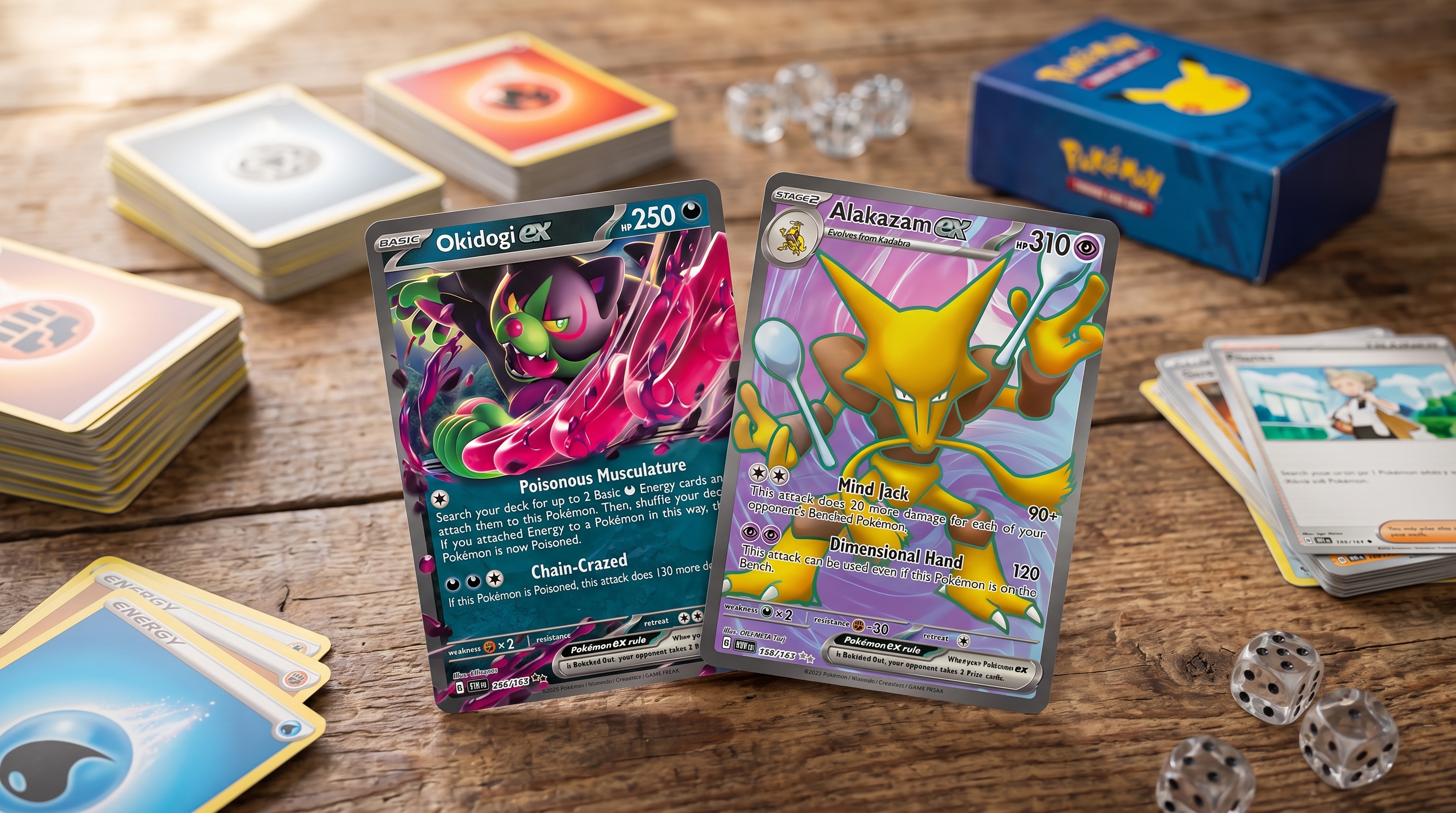
A competitive Standard deck costs less right now than a single booster box. Typical decklists for the current format hover between $20 and $50, with much of that cost concentrated in expensive Ace Spec cards and supportive Pokemon. The explosive popularity of illustration rare cards among collectors has reduced most double rare attackers to affordable prices. On the trainer side, cards like Iono and Arven sit at $1 to $3 each because they have been reprinted across multiple Scarlet and Violet sets.
Finding a pokemon tcg budget deck 2026 is straightforward because the format itself is cheap. Here are the strongest options available right now, grouped by strategy.
The prize-trade advantage
Standard games end when one player takes six prize cards. Knock out a regular Pokemon, take one. Knock out a rule-box ex, take two or three.
By forcing opponents to knock out six separate single-prize attackers, you buy valuable time to dismantle their complex strategies. Many premium strategies rely on multi-prize rule-box cards that require heavy resource investment. Affordable options punish this through fast, low-commitment attackers that instantly trade upward in value.
Your opponent powers up a massive ex over three turns. You knock it out with an inexpensive attacker and take two prizes. They need six knockouts to win. You need three.
The most accessible decks in Standard
Okidogi-Barbaracle
When discussing budget decks in the current format, this is the first deck that comes to mind. Okidogi-Barbaracle is a genuinely strong deck that uses Barbaracle to accelerate extra energy to Okidogi, an efficient attacker who becomes even stronger with the attachment of Darkness or Prism Energy. Thanks to its reliance on single-prize Pokemon and its preference for the inexpensive Ace Spec card Legacy Energy, this deck is as accessible as it gets.
For a new player walking into their first league night, start here.
Team Rocket engine decks
Decks that use the Team Rocket engine are able to effectively opt out of expensive staples in the current format thanks to the strength of effects like Team Rocket's Archer and Team Rocket's Transceiver. Of the two common variants, Spidops-Mewtwo lists are stronger and more consistent, but Honchkrow-Porygon2 can be a fun rogue option in its own right. This archetype also has a League Battle Deck available to upgrade from, though it should only be bought at a discount.
Stepping up: slightly pricier single-prize and ex-based decks
Mega Lucario ex
Mega Lucario is a very straightforward and powerful deck in the current format. Thanks to its inexpensive components, it manages to remain very inexpensive in spite of the included Meowth ex. Its upcoming League Battle Deck is also a nice option, though buying the cards individually will likely remain cheaper.
Alakazam
Alakazam is another strong single-prizer deck, which is always a good starting point for budget deck-building. Compared to Okidogi, Alakazam's matchup spread is much more volatile, feasting on unprepared decks but withering against decks that run high counts of Mist Energy, Rocky Fighting Energy, or Team Rocket's Articuno. It is slightly more expensive due to its inclusion of the relatively expensive Hilda and Fezandipiti ex, both of which help this deck consistently take Knock Outs every turn.
Pick Alakazam if your local meta lacks those specific counters.
Live eBay Deals
Sponsored · #ad SAVE $195.79
10x Pokemon Paldean Fates Booster Bundle, Perfect Order, Chaos Rising Sealed
 SAVE $489.44
Scarlet & Violet: Black Bolt Elite Trainer Box Pokémon TCG English 151 2025

Dragapult/Dusknoir
Listed at $34.23 on PokemonCard.io in Standard format. A mid-range budget option for players looking beyond single-prize strategies.
Spread and control: MunkiLass + Marnie's Grimmsnarl ex
This deck's list price is made much more expensive by the standard inclusion of Reset Stamp. If you are willing to compromise, Secret Box can be a passable substitute that will save you at least $10.
This deck is very intensive to play, making it a good choice for players who want to pick up a difficult spread deck on a tight budget. For players who prefer straightforward attacking, Okidogi-Barbaracle or Mega Lucario will feel more natural.
Regional-level budget pick: Festival Lead
The Festival Lead engine uses Dipplin to strike twice per turn cycle whenever Festival Grounds is active. This strategy overwhelms bulky two-prize decks while only yielding a single prize card upon knockout. It remains an incredibly safe selection for regional tournaments.
If you are preparing for a regional and want the safest budget option, Festival Lead is where to look.
Sourcing your deck: singles over packs
Buying singles is 5 to 10 times cheaper than opening packs. A booster pack in 2026 costs roughly $4 to $5 and contains one rare slot. The odds of opening the specific rare you need across a 60-card list are low enough that you would spend $150 to $400 in packs to assemble what singles deliver directly.
The trainer engine illustrates this clearly. A typical budget engine costs $12 to $18 total for 20+ trainer cards: 4x Iono, 4x Arven, 3 to 4x Nest Ball, 2 to 3x Boss's Orders, 2x Penny or Switch, and 2 to 3x Professor's Research. That is 20 cards for the price of three or four booster packs.
For tracking singles prices and finding deals on sealed product, check current seller deals or browse recommended products. The eBay deals tracker is worth bookmarking if you are sourcing from Australian sellers.
Mistakes that cost more than the deck
Charizard ex as your first build. The four copies of Charizard ex alone push past $60. That is more than enough to build Okidogi-Barbaracle and a Team Rocket engine deck combined.
Diluted trainer counts. Running 2 copies of 10 different trainers instead of 4 copies of 5 reliable ones reduces the probability of opening the card you need on turn 1, the single biggest predictor of early-game loss. Commit to full playsets of your best trainers.
Buying duplicates of shared cards. Many different Pokemon decks make use of the same trainers. If you want to have multiple decks, you can have shared playsets of trainers to put in whichever deck you are using at the time. Your second deck costs significantly less than your first because you already own the engine.
Where to start
If you have never built a competitive deck: Okidogi-Barbaracle. Single-prize strategy, the most accessible option in the format, genuinely strong results.
If you have some experience and want options: build the trainer engine first ($12 to $18), then pick an attacker package. Mega Lucario and Alakazam both slot into the same core trainer shell.
If you are preparing for a regional: Festival Lead is the safest competitive option.
Set up price alerts on the singles you need and buy when prices dip.
Live eBay Deals
Sponsored · #ad SAVE $409.92
Pokémon Center Pokémon TCG 30th Celebration Elite Trainer Box Pikachu 6+
 SAVE $405.79
Pokémon TCG 30th Celebration Pokémon Center Elite Trainer Box (ETB) | in Hand

📬 Monthly TCG Updates and Market Recap
Sign up for our mailing list. No spam - just the best deals and local market trends.
Please check your spam folder for the confirmation email!