Can AI Grade Your Pokemon Cards? What Actually Works
AI card grading apps can't replace PSA, but they catch the ~30% of cards that grade 7 or lower before you pay $79.99 per submission. Here's what the accuracy data shows and which apps are worth using.
Contents
- What AI Card Grading Actually Does (and Doesn't Do)
- How Accurate Are AI Grading Apps? The Numbers
- What It Costs to Grade With PSA in 2026
- How Much Does PSA Charge for a $10,000 Card?
- The Real Savings From Pre-Grading With AI
- Can ChatGPT Grade Your Pokemon Cards?
- The Best AI Card Grading Apps Compared
- Free Apps to Check Pokemon Card Values
- The Smart Workflow: AI First, Then PSA
PSA paused its Value tiers in June 2026. For a single-card submission the cheapest route now costs $79.99 per card before shipping, with the remaining Value Bulk pricing limited to Collectors Club bulk lots. Send in 20 cards and you are looking at roughly $1,600, except some of those cards will come back grade 7 or lower and the grading fee on those was wasted.
This is where a pokemon card grading app earns its place. Not as a PSA replacement. Not as an authenticity guarantee. As a triage tool that costs a dollar or two per card and tells you which ones are worth the postage.
Here is what the accuracy data actually says, what each app costs, and how to build a pre-screening workflow that saves real money.
What AI Card Grading Actually Does (and Doesn't Do)
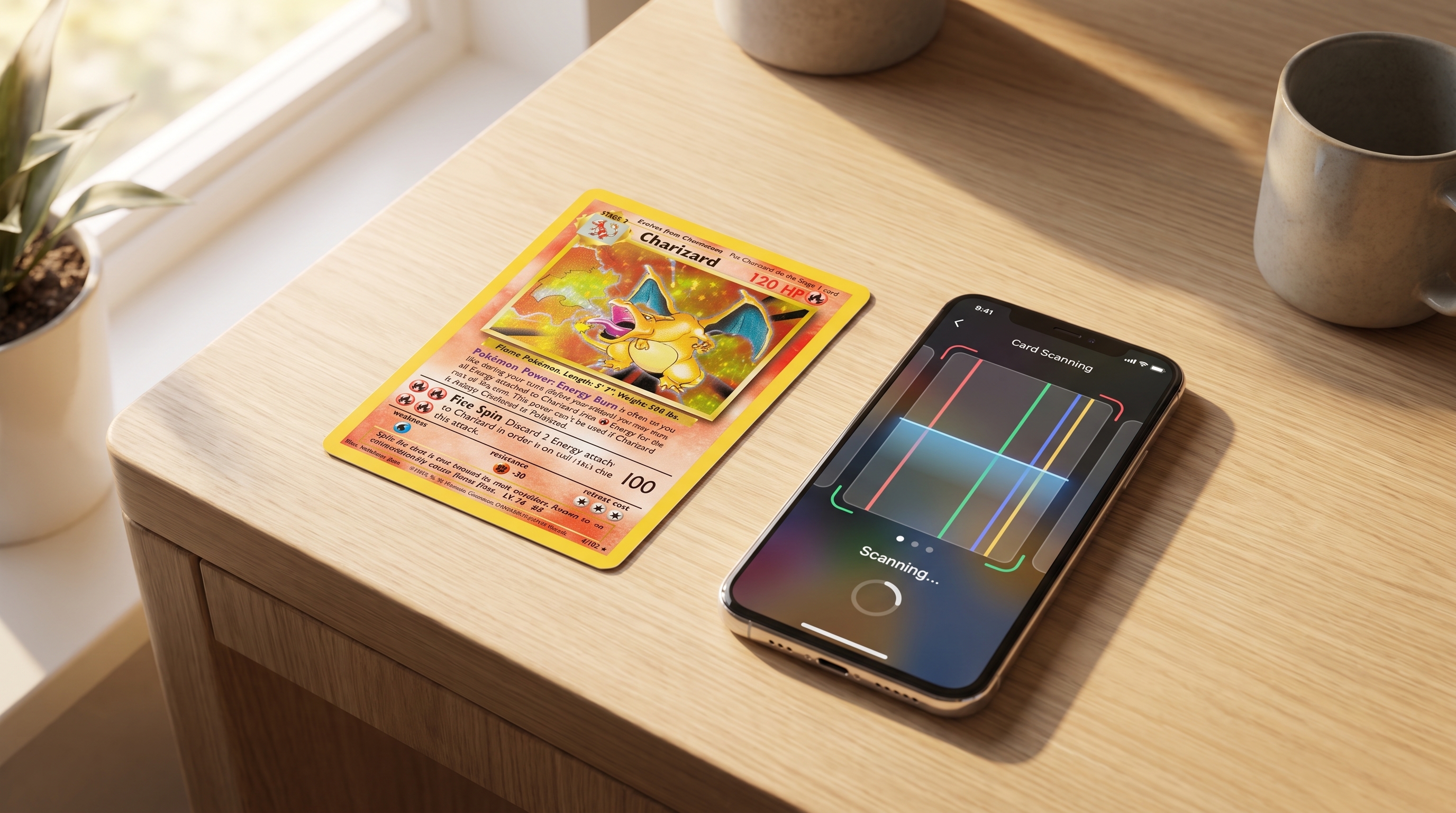
An AI grading app analyses photos of your card and estimates what a professional grader would assign. It looks at four things a camera can capture: centering, corner wear, edge wear, and obvious surface issues. Give it a sharp photo under good light and it returns a predicted grade in seconds.
What it cannot do is everything that requires physical inspection. Photos miss surface scratches that only appear at certain angles, hidden dents, print defects, and stock issues. AI cannot authenticate a card, spot a counterfeit, or detect alterations. It cannot encapsulate a card or give you a market-recognised grade. Those jobs still belong to PSA, BGS, CGC, and the other grading companies.
Think of it as a filter, not a verdict. It tells you which cards are worth the real grading fee and which ones should stay in the binder.
How Accurate Are AI Grading Apps? The Numbers
Most AI grading tools make claims. Only SnapGradeAI has published verified data against actual PSA returns.
Across 412 cards that were SnapGraded and then submitted to PSA, the AI matched the PSA grade within ±0.5 in 87% of cases. Within ±1.0, it hit 96%. If SnapGradeAI predicts a 9, the real PSA grade lands between 8.5 and 9.5 nearly nine times out of ten. The full log is public on their Track Record page, misses included.
There is a built-in safety valve. If the AI's confidence on a given card drops below 70%, the credit refunds automatically. You only pay for assessments the model is confident enough to stand behind. SnapGradeAI is explicit that it is not as accurate as official grading. PSA, BGS and CGC use trained human graders. The AI is a pre-grading tool that estimates the most likely PSA outcome so you can decide whether a card is worth submitting.
Other tools like TCGrader and CardGrade describe their technology in similar terms but have not published an equivalent verified comparison log. The 87% figure from SnapGradeAI is the only public benchmark with a named sample size, which makes it the reference point when evaluating accuracy claims across the category.
What It Costs to Grade With PSA in 2026
The grading economics changed in June 2026 when PSA paused its Value tiers. Those cheaper options, starting at $24.99 for Value Bulk, were the default for collectors submitting modern cards. With them gone, Regular at $79.99 per card is now the entry point for single-card submissions.
Here is the full tier structure as of 2026:
| Tier | Cost Per Card | Declared Value Max | Turnaround |
|---|---|---|---|
| Value Bulk | $24.99 | $200 | ~65 days |
| Regular | $79.99 | $1,500 | ~45 days |
| Express | $149 | $5,000 | ~25 days |
| Super Express | $349 | $10,000 | ~10 days |
| Walk-Through | $599 | $25,000 | ~7 days |
| Premium 1 | $999 | $50,000 | ~5 days |
Value Bulk is listed as paused. Do not plan a submission around it returning.
On top of the per-card fee, every submission incurs a one-time handling fee of roughly $10 plus return shipping starting at $15. For Australian collectors, international round-trip shipping and customs add another $50 to $150 per submission.
For context, BGS charges roughly $30 per card, CGC about $25, SGC $15 to $30, and TAG $20 and up. PSA commands a premium, and the value-tier pause widened the gap.
How Much Does PSA Charge for a $10,000 Card?
A card worth five figures cannot go through the Regular tier. PSA prices grading by declared value because it takes on the financial risk of insuring and handling your card. A $10,000 card requires Super Express ($349) or Walk-Through ($599), and the faster turnaround on those tiers reflects both the premium you pay and the shorter window PSA wants to hold that level of liability.
Declared value has a trap worth knowing. If PSA decides you understated the card's value, they upcharge you to the higher tier and the card does not ship back until you pay. It is not a negotiation. Undervaluing a card to save on grading fees is the most expensive shortcut in the hobby.
The Real Savings From Pre-Grading With AI
The math on pre-grading is straightforward once you pick an attrition rate. SnapGradeAI's own cost calculator assumes roughly 30% of submitted cards return at grade 7 or lower. PSA publishes a more optimistic number, saying 90% of ultra-modern sport and modern trading card game cards have graded PSA 8 or higher, so treat 30% as a cautious planning figure rather than a measured one. On that assumption, at $79.99 per card, a 20-card submission wastes about $480 on cards that come back with grades nobody brags about.
Here is what happens if you run those same 20 cards through AI first:
Without pre-screening: 20 cards × $79.99 = $1,599.80. Roughly six return at grade 7 or below.
Live eBay Deals
Sponsored · #ad SAVE $464.48
Pokémon TCG Shining Fates Elite Trainer Box Factory Sealed
 SAVE $143.73
3x Pokémon Scarlet & Violet Prismatic Evolutions Sealed Elite Trainer Box ETB

Get notified immediately.
Receive alerts when stock is available, so you don't miss out.
Pulled something worth grading? Ark Grading does it in Melbourne, no overseas shipping, no 5-month wait. CardTracker readers get 5% off with code CARDTRACKER.
Grade with Ark →With AI pre-screening: 20 cards × $1.20 = $24. The AI flags roughly six as unlikely to hit grade 9+. You submit the remaining 14 cards: 14 × $79.99 = $1,119.86.
Net savings: roughly $456 on a single 20-card submission. The AI pre-screening cost is $24 to avoid roughly $480 in wasted grading fees.
For Australian collectors the savings compound. International shipping and customs add $50 to $150 per submission. Pre-screening at $1 to $2 per card with no shipping lets you filter out poor-grade candidates before they cross an ocean twice.
SnapGradeAI reports its users have collectively saved $2.4 million in PSA fees through pre-screening. That number is self-reported, but the per-submission math backs up the mechanism.
Can ChatGPT Grade Your Pokemon Cards?
You can upload a photo of a card to ChatGPT and ask for a grade estimate. People have done it. The results are directionally useful but imprecise. ChatGPT is a general-purpose model trained to reason about images broadly. It was not trained specifically on card grading, does not measure centering with pixel precision, and cannot detect the fine surface scratches that separate a PSA 8 from a PSA 10.
Dedicated pokemon card grading apps like TCGrader and SnapGradeAI use computer vision models built specifically for card analysis. They are trained on card images, they measure centering ratios and edge wear systematically, and they output a structured grade rather than a conversational estimate.
The distinction matters because a half-grade miss changes the economics of a submission. ChatGPT might give you a rough sense of whether a card is in good shape or beat up. A purpose-built app gives you a number you can make dollar decisions on.
The Best AI Card Grading Apps Compared
Three tools dominate the AI card grading category.
SnapGradeAI has the transparency advantage. Its 412-card verified comparison log with 87% accuracy within ±0.5 is the only published benchmark in the space. The credit model charges per card, and the automatic 70% confidence threshold refund means you never pay for a guess.
TCGrader is UK-based and starts every new account with one free grading credit. After that, credits cost a few pence each, with subscription plans for collectors who grade in volume: £9.99/month for 25 grades, £19.99/month for 75 grades, and a £49.99/month Dealer Console tier aimed at card shops, which bundles 250 AI assessments with inventory and point-of-sale tools. The app offers both Quick and Precision scan modes, giving you a fast estimate or a deeper analysis depending on how much the card is worth.
CardGrade grades across 16 zones in about 60 seconds, though it has not published a verified comparison log with the sample size and methodology that SnapGradeAI has.
| App | Accuracy Data | Free Tier | Paid From |
|---|---|---|---|
| SnapGradeAI | 87% within ±0.5 (412 verified) | Free credit on signup | ~$1.20/card |
| TCGrader | Not independently published | 1 free credit | A few pence/card; subs from £9.99/mo |
| CardGrade | No published verification log | No | Credit-based |
If verifiable accuracy is your priority, SnapGradeAI is the only option with published numbers. If you want to try AI grading for free, TCGrader gives you one credit at signup.
Free Apps to Check Pokemon Card Values
Before you grade, you need to know what a card is worth. Several free apps handle scanning and pricing.
The TCGplayer app scans cards and pulls live market prices from their marketplace, one of the largest trading card platforms. PokeScope claims 50,000 users and returns prices in about two seconds with no sign-up required. Rare Candy and DittoDex round out the free scanning category, each with their own price data sources and collection tracking features.
None of these free scanners offer AI grading. They tell you what a card is worth, not what condition a grader would assign. But knowing the value is the first filter: a card worth $15 raw does not need a $79.99 grading fee no matter how clean it looks.
The Smart Workflow: AI First, Then PSA
The most cost-effective approach combines free scanning, AI pre-grading, and selective PSA submission. Here is the order that makes the numbers work:
1. Scan and price everything. Use a free scanner to identify which cards carry enough raw value to justify grading at all. Anything under about $50 raw is rarely worth the $79.99 PSA minimum unless it has clear PSA 10 potential.
2. Pre-grade the candidates. Run cards that pass the value filter through an AI grading app. SnapGradeAI or TCGrader will flag centering issues and visible wear that would cap the grade.
3. Set a cutoff and stick to it. If the AI predicts below a 9, keep it raw. The PSA premium over raw value on an 8 or lower rarely covers the grading fee plus shipping.
4. Submit only the winners. Cards predicted at 9 or above go to PSA. Cards that miss the cutoff stay in the collection or get sold raw.
This workflow is particularly relevant for Australian collectors buying cards on eBay. When you are assessing condition from listing photos before you even bid, an AI pre-screen tells you whether that "NM/M" description holds up. CardTracker helps you find deals across eBay Australia. Pairing that with a pokemon card grading app to vet condition from photos before you buy closes the loop: find the card at the right price, check it is worth grading, then send only the best to PSA.
The goal is not to replace human grading. It is to stop paying $79.99 for cards that were never going to hit a 9.
Live eBay Deals
Sponsored · #ad SAVE $315.22
Pokémon TCG Shining Fates Elite Trainer Box Factory Sealed
 SAVE $498.85
Paldea Evolved Elite Trainer Box SV02 PAL Pokemon English Sealed 36 PC TCG CCG

Explore CardTracker.au
📬 Monthly TCG Updates and Market Recap
Sign up for our mailing list. No spam - just the best deals and local market trends.
Please check your spam folder for the confirmation email!