How TCG Pocket Changed What Physical Pokemon Cards Are Worth
TCG Pocket drove 100 million new players into Pokemon cards, spiking physical prices by 2-3x. Now its revenue has dropped 87%. Here is what that means for card values.
Contents
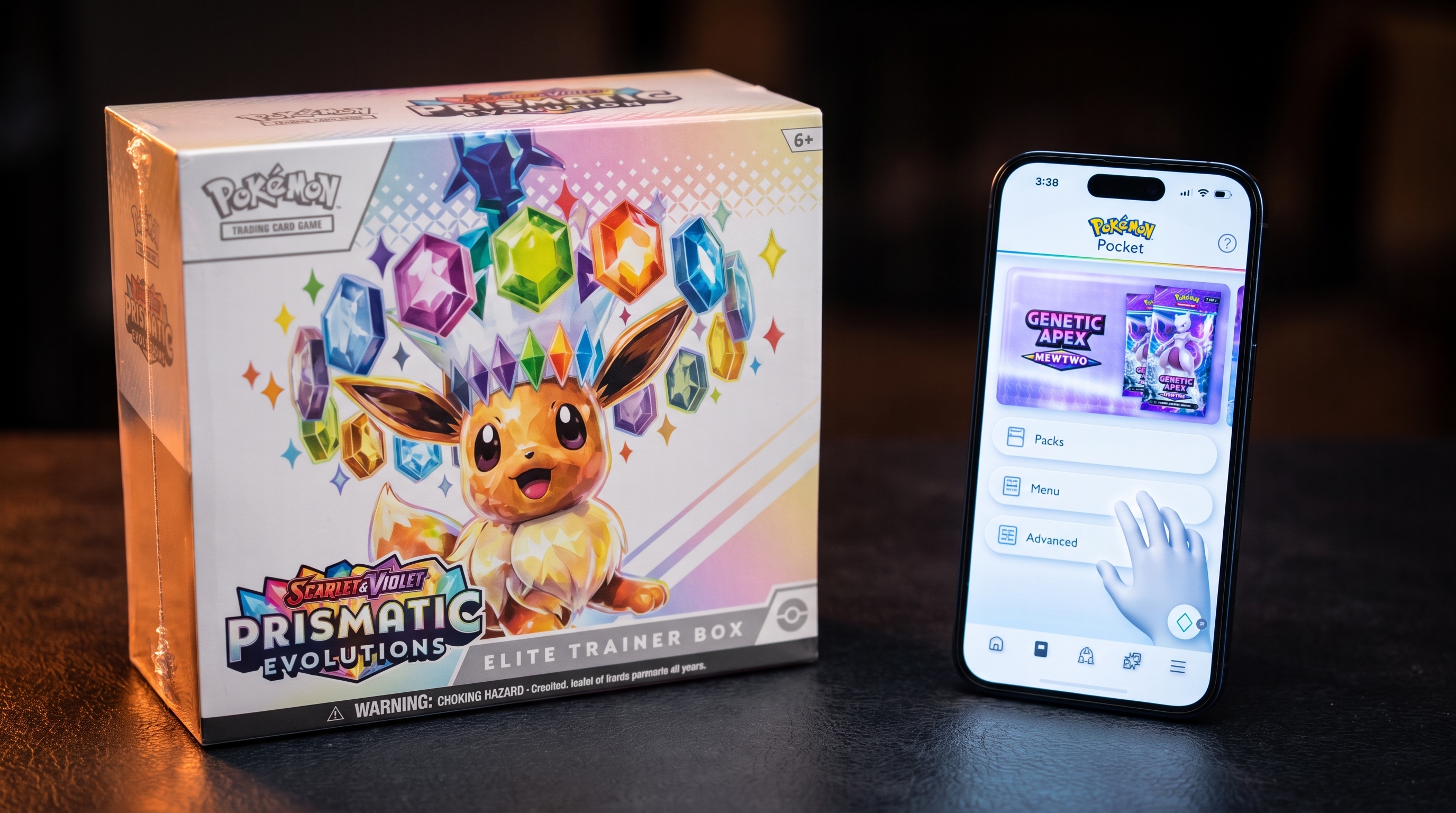
Pokemon TCG Pocket launched on October 30, 2024. Within four months, over 100 million people downloaded it and spent more than half a billion dollars on digital packs. Physical card prices moved in lockstep. Sealed products hit two to three times MSRP. A card worth $15 before launch reached $70 by February 2025. Game stores got robbed.
Then Pocket's player base started shrinking, and the physical market followed it down.
The pokemon tcg pocket effect on card prices is the single biggest demand shift in modern Pokemon collecting. Understanding the mechanics of that shift, both up and down, is how you avoid buying at the wrong time.
Pocket as an onboarding machine
The app did not just attract existing collectors. It trained new ones. TCG Pocket shows players what rare cards look like (full-card illustrations), where they come from (crinkly packs), and what "success" looks like (completing a set). That is a free masterclass in the dopamine loop that drives physical collecting.
Google search data traces the pipeline clearly. When worldwide downloads hit 30 million on November 7, 2024, searches for "pokemon cards" were roughly 63% higher than the September baseline. At 60 million downloads in mid-December, searches were 109% higher. By late February 2025, when Pocket announced 100 million downloads, search interest had climbed 180% above September 2024 levels.
Those searches converted into purchases. TCGplayer's own marketplace data shows that physical card and sealed product prices were flat or barely positive throughout 2024, then started climbing steeply in October and kept going through February 2025.
The proof: 151 vs. Prismatic Evolutions
If popular sets alone caused price explosions, the 151 expansion should have done it in 2023. Everyone wanted 151. It was arguably the most hyped modern set at release. But its Elite Trainer Boxes launched only slightly above MSRP because The Pokemon Company printed enough to meet demand. Supply met the existing audience.
Fast-forward to early 2025. Prismatic Evolutions ETBs had been costing more than twice MSRP on the secondary market since December. And 151 ETBs, a set nearly two years old at that point, climbed to $200, or four times MSRP.
Same hobby. Same printing infrastructure. The variable that changed was audience size, and the variable that changed audience size was Pocket.
Pocket cards are worth nothing (and cost a fortune)
A reasonable question at this point: if the app is so popular, why would anyone leave it for physical cards?
Because Pocket cards are pixels in a database. You cannot trade them for money, sell them on a marketplace, or hold them in your hand. And the economics of chasing them digitally are punishing.
Getting a specific rare card through TCG Pocket's Pack Points system costs the equivalent of $87 USD. On TCGplayer, a near-mint physical Charizard EX from Obsidian Flames goes for about $3. The rarest digital cards cost 2,500 Pack Points, roughly $435 USD, or over 200 days of opening free packs.
Live eBay Deals
Sponsored · #ad SAVE $464.48
Pokémon TCG Shining Fates Elite Trainer Box Factory Sealed
 SAVE $143.73
3x Pokémon Scarlet & Violet Prismatic Evolutions Sealed Elite Trainer Box ETB

Get notified immediately.
Receive alerts when stock is available, so you don't miss out.
Got a single worth protecting? Ark Grading does it in Melbourne, no overseas shipping, no 5-month wait. CardTracker readers get 5% off with code CARDTRACKER.
Grade with Ark →That gap between digital cost and physical value is part of what pushes engaged Pocket players toward physical collecting. The app teaches you to want cards, then makes the most desirable ones absurdly expensive to get digitally. Physical packs offer better odds and you walk away with something you actually own.
The decline
Pocket's revenue peaked at $235.3 million in November 2024. By April 2026, monthly revenue had fallen to $31.4 million, an 87% drop from peak. The first six months generated $894 million in player spending; the next six months brought in $441.5 million, down 51%.
Player counts followed the same trajectory. In January 2025, roughly 3.1 million players were active. By October 2025, that number was approximately 875,000, a decline of around 72%.
New expansions still produce revenue spikes, but none have reached the initial highs seen at launch. The overall revenue generated is on a gradual decline even as new card packs reliably trigger spending surges.
The physical market tracked the decline. Search interest in "pokemon cards" peaked at the end of January 2025 when Space-Time Smackdown launched on Pocket, and has not reached those heights since.
Where prices sit now
By late 2025, the physical card market had entered one of its sharpest cool-down phases in recent years. Sealed products that once sold out within hours sat unsold on shelves. Graded cards lost value.
Pocket's declining player pipeline is one driver, but not the only one. The correction has multiple causes: overproduction by The Pokemon Company, too many chase card variants diluting collector attention, macroeconomic pressure on discretionary spending, and speculation fatigue after years of "everything goes up."
Pocket was the ignition. These other factors are the sustained burn.
What this means if you are buying
The market is returning to fundamentals. Character demand, artwork quality, and true rarity are what hold value now, not FOMO or speculation momentum. Key character cards (Charizard, Pikachu, Eeveelutions) are available at discounts compared to their early-2025 peaks. Graded copies are more accessible than they have been in over a year.
For collectors who sat out the Pocket-fuelled surge, this is the upside of the correction. The cards did not get worse. The hype premium came off.
If you want to track how specific cards and sealed products are moving in the Australian market, CardTracker's price tools pull from actual sold data rather than inflated asking prices. Knowing the difference between an eBay listing at $120 and recent sales at $75 is how you avoid paying the old Pocket-era premium on cards that have already corrected.
The Pocket effect on physical card prices was real, measurable, and well-documented. The question going forward is whether any future app update or expansion can reignite that pipeline, or whether the physical market has settled into a new, lower baseline. For now, the data points toward the latter.
Live eBay Deals
Sponsored · #ad SAVE $315.22
Pokémon TCG Shining Fates Elite Trainer Box Factory Sealed
 SAVE $288.61
Pokémon TCG 30th Celebration Classic Collection 1 Pack PRESALE

Explore CardTracker.au
📬 Monthly TCG Updates and Market Recap
Sign up for our mailing list. No spam - just the best deals and local market trends.
Please check your spam folder for the confirmation email!