Best Pokemon Card Value Scanners and Pricing Apps
Compare the best pokemon card value scanner apps for 2026. Eyevo, TCGPlayer, Dittodex, PokeScope and more, plus how to adjust US prices for the Australian market.
Contents
- What Separates a Good Scanner From a Bad One
- Eyevo: Fastest and Most Accurate
- Dittodex: Best Free Option
- TCGPlayer App: Best for Buying and Selling
- PokeScope: Best for Set Completion and Tracking
- PriceCharting: Best for Historical Research
- Collectr: Best for Portfolio Tracking
- Rare Candy: Creator Favourite
- The Australian Pricing Gap These Apps Cannot Fill
- When to Think About Grading
- Frequently asked questions
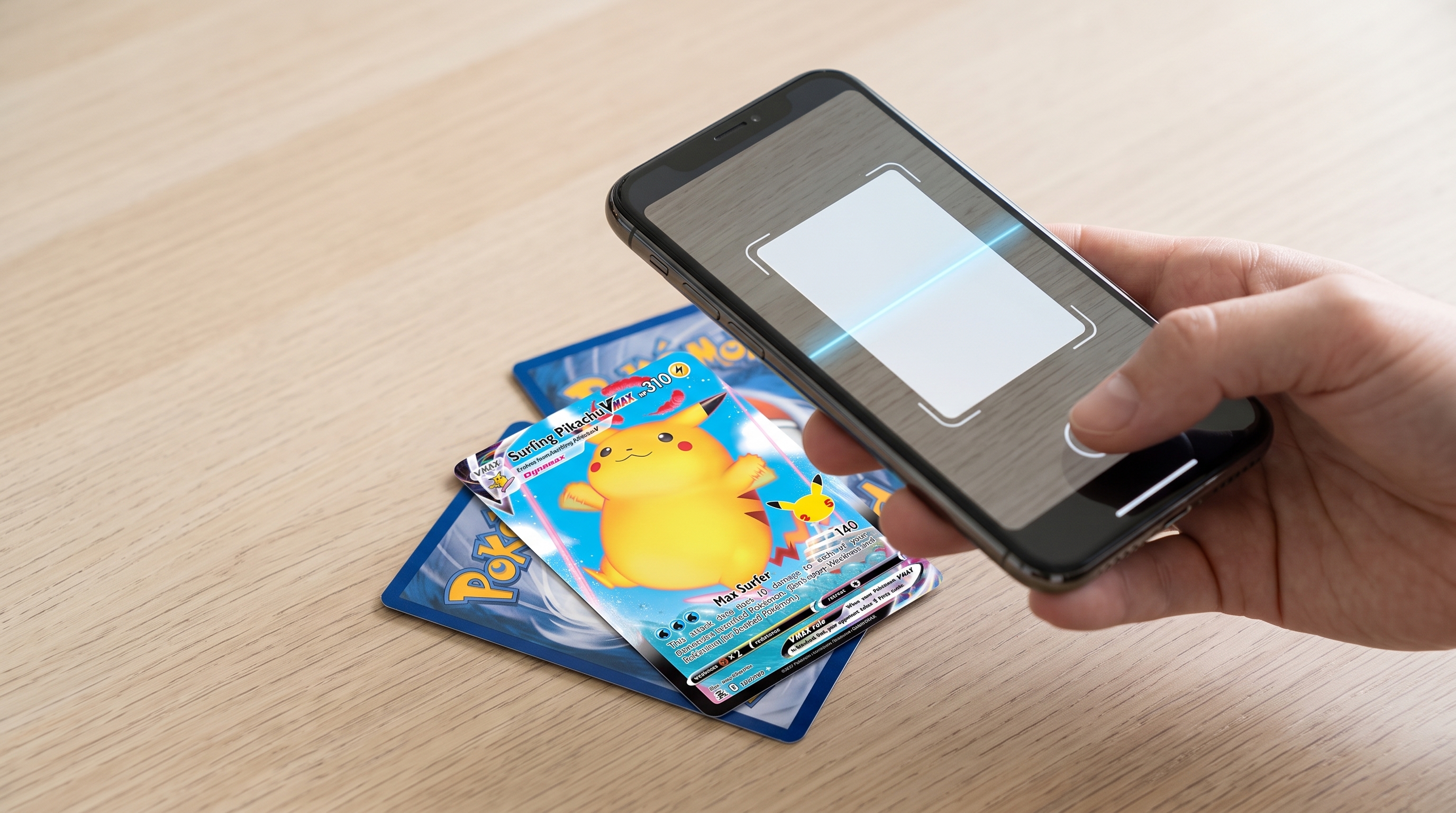
A pokemon card value scanner does one useful thing: it turns a phone camera into a price lookup. Point it at a card, get a number. Simple enough. But the number you get depends entirely on which app you use, which price source it pulls from, and whether it correctly identified your card's variant in the first place.
That last part matters more than most collectors realise. A reverse holo and a regular rare of the same card can differ in price by 10x. The scanner that identifies "a Charizard" is useless. The one that identifies which Charizard (set, number, holo pattern, edition) is the one worth installing.
And for Australian collectors, there is a second problem none of these apps solve. Every scanner listed here pulls prices from TCGPlayer (US) or Cardmarket (EU). None of them show what cards actually sell for on eBay Australia, where import costs, limited restocks, and local demand push prices in directions the US market does not predict. A scanner gives you a starting point. Translating that number to the Australian market takes one more step.
Here is how the major apps compare, and how to close that gap.
What Separates a Good Scanner From a Bad One
Five things determine whether a pokemon card value scanner is worth keeping on your phone:
- Speed. Scanning a binder at 1 second per card is an afternoon. At 3 seconds per card, it is a week.
- Variant accuracy. Does it distinguish reverse holo from regular, 1st Edition from Unlimited, Poke Ball pattern from Master Ball pattern? Identifying the right variant is where most scanners lose points.
- Price data sources. TCGPlayer reflects current marketplace asking prices from sellers. Market price reflects broader data including eBay and auctions. The two can diverge meaningfully.
- Graded card support. Can it recognise a PSA or CGC slab and show grade-specific prices?
- Account requirements. Some apps let you scan immediately. Others require sign-up before your first scan.
| App | Speed | Variant Accuracy | Price Sources | Graded Support | Cost |
|---|---|---|---|---|---|
| Eyevo | Sub-second | 96% (AI + OCR) | TCGPlayer, Cardmarket, eBay sold | PSA, BGS, CGC, SGC, ACE, TAG | Paid |
| TCGPlayer | 2.1s/card | Good | TCGPlayer only (US) | No | Free |
| Dittodex | Fast | Good | Real-time market | No | Free, ad-free |
| PokeScope | Fast | Good | TCGPlayer, Cardmarket, eBay, auctions | Yes | Free/Paid |
| PriceCharting | Moderate | Good | Historical + graded | Yes | Free/Paid |
| Collectr | Moderate | Good | Market + graded (PSA, Beckett) | Yes | Free (limited scans) |
| Rare Candy | Fast | Good | Market + graded | Yes | Paid |
Eyevo: Fastest and Most Accurate
Eyevo scanned a 20-card benchmark in under one second per card with 96% accuracy. It runs dual scanning modes (AI image recognition and OCR text scanning), which is why it handles holographic cards that give other scanners trouble.
Prices pull from TCGPlayer (USD), Cardmarket (EUR), and eBay sold listings. Graded slab scanning covers six grading companies: PSA, BGS, CGC, SGC, ACE, and TAG, with grade-specific eBay comps for each.
The gap: Eyevo lacks grading ROI analysis. It will show you what a raw card is worth, but it will not tell you whether sending that card to PSA or CGC makes financial sense. For that calculation, you need to do the maths yourself. iOS-first.
Dittodex: Best Free Option
Dittodex is 100% free and ad-free. No paywalls, no skip-ad buttons, no limited scan counts. It scans Japanese cards alongside English ones and shows real-time market values.
For casual collectors who want to check a card's price without committing to a subscription or creating an account, Dittodex removes every barrier. It also includes built-in collection tracking, so you can catalogue as you scan.
The trade-off is depth. Dittodex does not offer the graded slab recognition or multi-source price comparison of paid alternatives. If you need to know what a PSA 9 version sells for versus raw, you will need a different tool.
TCGPlayer App: Best for Buying and Selling
The TCGPlayer app is not just a scanner. It is an online shop where you can buy singles directly from scan results. Scan a card, see the price, buy it from a verified seller in the same workflow.
Scanning speed is slower at 2.1 seconds per card. It covers US market prices only, with no Cardmarket data and no graded card recognition. One quirk to watch: the app shows three price figures (Market Price, Listed Median, and Lowest Listing) that can differ by 10 to 30% on popular cards. Which number you use as "the price" depends on whether you are buying or selling.
For collectors already transacting on TCGPlayer, the app makes sense as an all-in-one tool. For pure price checking, the slower scan speed and US-only data are limitations.
PokeScope: Best for Set Completion and Tracking
PokeScope is used by 50,000+ trainers and updates prices hourly from TCGPlayer, Cardmarket, eBay sold listings, and auction data. That hourly cadence matters during set releases, when prices shift fast.
Beyond scanning, PokeScope adds price alerts, a trade calculator, collection management with export, and an offline mode for cached prices. The price alerts are particularly useful: set a target on a chase card you want, and get notified when it drops to your number.
For collectors working through a set and tracking which cards they still need at what price, PokeScope combines scanning with the management layer that standalone scanners lack.
PriceCharting: Best for Historical Research
PriceCharting is less about quick scanning and more about understanding where a card's price has been. It reveals every card's value history, including graded prices, so you can see whether a card is at its peak, in a trough, or trending.
Live eBay Deals
Sponsored · #ad SAVE $464.48
Pokémon TCG Shining Fates Elite Trainer Box Factory Sealed
 SAVE $143.73
3x Pokémon Scarlet & Violet Prismatic Evolutions Sealed Elite Trainer Box ETB

Get notified immediately.
Receive alerts when stock is available, so you don't miss out.
Got a single worth protecting? Ark Grading does it in Melbourne, no overseas shipping, no 5-month wait. CardTracker readers get 5% off with code CARDTRACKER.
Grade with Ark →This is the tool for collectors deciding whether to sell now or hold. If a card spiked after a tournament result, PriceCharting shows you the pattern of previous spikes and how long they lasted. Pair it with a faster scanner for identification and use PriceCharting for the research layer.
Collectr: Best for Portfolio Tracking
Collectr's strength is its portfolio section, which tracks total collection value with up-to-date insights on individual cards and your holdings as a whole. It pulls graded card prices from PSA, Beckett, and other grading companies.
The free version limits the number of scans, which pushes serious collectors toward a paid tier. But if you want a single dashboard showing what your entire collection is worth today, including graded slabs, Collectr is built for that.
Rare Candy: Creator Favourite
Rare Candy is recommended by content creators Leonhart and Pokilegends and is commonly seen at Pokemon TCG events where sellers use it to check values on the spot. Clean UI, fast scans, and it includes graded card prices.
If you watch Pokemon TCG content on YouTube and want the same tool the creators are using, Rare Candy is the pick. Its event presence also means it handles the real-world conditions of convention lighting and card sleeves reasonably well.
The Australian Pricing Gap These Apps Cannot Fill
Every pokemon card value scanner listed above pulls US or European prices. For Australian collectors, those numbers are a floor, not a ceiling.
Import costs, GST on overseas purchases, constrained local restocks, and the dynamics of eBay AU as the dominant local marketplace all push Australian prices above what TCGPlayer shows. A card listed at $30 USD on TCGPlayer might sell for $60 to $80 AUD on eBay Australia, depending on local supply.
Worth being clear on the GST point: buying from an Australian-based eBay or Facebook Marketplace seller does not add GST on top of the listed price, it is already included. GST only becomes a real extra cost when you import a card directly from an overseas seller, where it is collected on the purchase (and, on larger consignments, alongside import duty at the border).
To get actual Australian prices, two steps:
Check eBay AU sold listings. Filter by "Sold items" on eBay Australia to see what people actually paid, not what sellers are asking. This is the most reliable source for local market rates. Our guide on how to sell Pokemon cards on eBay walks through reading sold data effectively.
Track restocks and deals locally. Scanner prices assume US retail availability. Australian stock levels are different. CardTracker.au's deal pages track what Australians are actually paying for sealed product and singles on eBay AU, so you can see whether local prices are running hot or cooling.
If you are trying to figure out what a specific card is worth in Australia, our guide to Pokemon card values covers the full process from identification through to local pricing.
One thing no scanner app checks: whether the card is genuine in the first place. These tools identify the set, number, and variant from the image you give them and price it accordingly, but they assume the card itself is real. Counterfeit cards are increasingly common on marketplaces, particularly for expensive chase cards, so it is worth confirming authenticity separately before you trust a high scanned value. Our guide to spotting fake Pokemon cards covers the physical checks to run.
When to Think About Grading
A scanner shows you raw card value. Grading can multiply that number. Graded cards typically sell for 2 to 5x more than ungraded cards, but it costs $15 to $50+ per card depending on the service and turnaround time.
The general rule: professional grading through PSA or BGS is recommended for cards worth $50+ in near mint condition. Below that threshold, the grading fee eats into or exceeds the premium you would gain.
Several factors affect whether grading makes sense for a specific card: condition, edition (1st Edition vs Unlimited, Shadowless), holographic type, and the set's age and rarity. A card that scans at $60 raw but has visible centering issues will grade lower and may not justify the cost. Our grading guide covers PSA, CGC, and Beckett in detail.
The scanner is step one. It tells you whether a card is worth investigating further. The grading decision comes after you have assessed condition, checked the graded price premium for that specific card, and done the maths on fees and turnaround time.
Frequently asked questions
Do Pokemon card scanner apps show Australian prices?
No. Every major scanner app pulls from TCGPlayer (US) or Cardmarket (EU). None of them show eBay Australia sold prices directly, so treat the scanned number as a US-market starting point rather than a local one. Check eBay AU sold listings, or CardTracker's market pages, for the actual Australian figure.
Which Pokemon card scanner app is the most accurate?
Eyevo has tested at around 96% variant accuracy using combined AI and OCR scanning, which is notably higher than most competitors, particularly on holographic cards that are harder to read.
Is there a free Pokemon card scanner app?
Dittodex is fully free and ad-free with no scan limits. The TCGPlayer app is also free but is US-price-only and slower to scan. Several other apps offer a free tier with a capped number of scans before requiring a paid subscription.
Can a scanner app tell me if my card is fake?
No. These apps identify the set, card number, and variant from the image and price it accordingly, but they do not verify authenticity. See our guide to spotting fake Pokemon cards for the physical checks to run yourself.
Is it worth grading a card based on the scanned price?
As a general rule, professional grading through PSA or BGS starts to make financial sense for cards worth $50 or more raw in near mint condition. Below that, grading fees can eat into or exceed the value gained, so use the scanned price as a first filter, not the final word.
Live eBay Deals
Sponsored · #ad SAVE $315.22
Pokémon TCG Shining Fates Elite Trainer Box Factory Sealed
 SAVE $498.85
Paldea Evolved Elite Trainer Box SV02 PAL Pokemon English Sealed 36 PC TCG CCG

Explore CardTracker.au
📬 Monthly TCG Updates and Market Recap
Sign up for our mailing list. No spam - just the best deals and local market trends.
Please check your spam folder for the confirmation email!